How to disclose sponsored posts: the US, UK and India rules creators need to know
A free product counts. So does an affiliate link. The label has to be impossible to miss, and the platform's paid-partnership toggle on its own may not be enough. Here is what regulators in the US, UK and India actually require.

Every major creator market now has rules on labelling paid content, and they agree on more than they differ. If a brand gave you something, whether money, a free product or a commission, your audience has to be told clearly and immediately. This guide covers the United States (FTC), the United Kingdom (ASA and CMA) and India (ASCI and the Department of Consumer Affairs), and links to each regulator's own guidance so you can check the detail. It is general information, not legal advice.
When you have to disclose
All three regimes are triggered by any connection with a brand that your audience wouldn't expect, not only by cash payments:
- Payment of any kind, including fees, commissions and affiliate income. The UK's ASA says that once you use an affiliate link or code you are acting as an advertiser.
- Free or discounted products, including gifts you didn't ask for. ASCI's guidelines explicitly cover products "received unsolicited", and the ASA treats any incentive, requested or not, as making the content an ad.
- Trips, events and perks paid for by a brand.
- Personal, family or employment relationships with the brand. The FTC's guidance names financial, employment, personal and family relationships.
The FTC adds that you must disclose even if you believe your review is unbiased, and that you can't talk up a product you haven't tried or praise one you think is bad. India's Department of Consumer Affairs similarly says the product should have been actually used or experienced by the person endorsing it.
Which labels count
The biggest practical difference between the three markets is the wording they accept.
| Label | US (FTC) | UK (ASA/CMA) | India (ASCI) |
|---|---|---|---|
| Ad / #ad / Advertisement | ✓ | ✓ preferred | ✓ |
| Sponsored / #sponsored | ✓ | ✗ advised against | ✓ |
| Collab / Collaboration | ✗ "collab" too vague | Not explicit; use "Ad" | ✓ "Collaboration" (full word) |
| Gifted / Free gift | Use a clear sentence | ✗ not enough alone | ✓ "Free gift" |
| Affiliate | Use a clear sentence | ✗ "aff" not enough | ✓ |
| sp, spon, collab | ✗ | ✗ | ✗ |
United States. The FTC says "advertisement", "ad" and "sponsored" work, and #ad or #sponsored are fine. It warns against vague terms like "sp", "spon" or "collab", and against "thanks" or "ambassador" on their own. A full sentence such as thanking a named brand for the free product is acceptable.
United Kingdom. The ASA and CMA want the label to say explicitly that it's advertising. CAP guidance says "Ad", "Advert", "Advertising" and "Ad Feature" are very likely acceptable, with or without a hashtag. It advises against "sponsored" because people read it in different ways, and says "gifted", "supported by", "aff" and "sp" aren't enough.
India. ASCI's guidelines list Advertisement, Ad, Sponsored, Collaboration, Partnership, Employee, Free gift and Affiliate, and also recognise Instagram's "Paid Partnership" tag and YouTube's "Includes Paid Promotion" tag. The government's 2023 guidance lists "advertisement" or "ad", "sponsored" and "paid promotion" or "paid".
If you post for audiences in more than one country, use "Ad". It is the only label all three regulators clearly accept.
Where the label goes
A correct label in the wrong place doesn't count. The rules line up closely:
- Up front, with the message itself. Not only in your bio, not at the end of a long caption, and not behind "more" or "see more".
- Not buried in hashtags. The FTC, ASA, ASCI and Indian government all warn against hiding the label in a cluster of hashtags or links.
- On the image or in the video. For photos, the FTC says to superimpose the disclosure over the picture. For video, it should be in the video, not just the description. The FTC's 2023 Endorsement Guides say a visual claim needs a visual disclosure and a spoken claim needs a spoken one, and that on social media a disclosure should be unavoidable.
- In the same language as the post. The FTC says so explicitly; ASCI accepts English or the language of the ad.
- Repeated in livestreams. The FTC asks for periodic repeats. ASCI asks for an announcement at the start and end, and India's 2023 guidance asks for the disclosure to be shown continuously and prominently.
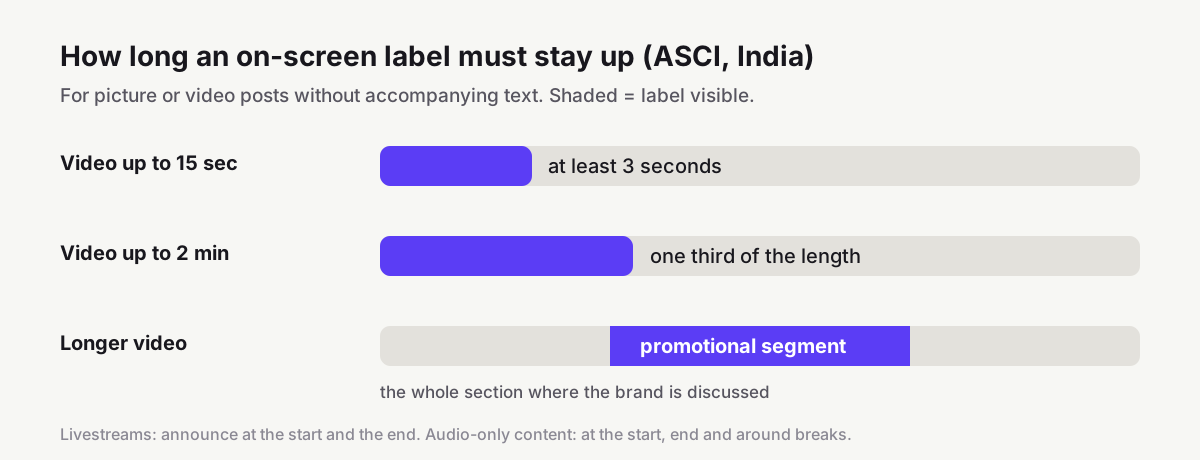
Platform toggles help, but don't rely on them alone
Each platform has a built-in label: Instagram's Paid partnership tag, TikTok's commercial content disclosure toggle (TikTok's Branded Content Policy requires you to turn it on for branded content) and YouTube's paid promotion checkbox, which adds a label at the start of the video. Use them. But regulators are consistent that they may not be enough by themselves:
- The FTC says not to assume a platform's disclosure tool is good enough. Its 2023 Endorsement Guides give an example where relying only on a platform label, shown in small text for a few seconds, is not clear and conspicuous.
- The ASA says a platform label may not be enough on its own and suggests adding "Ad" if in doubt.
- ASCI says platform tools should be used in addition to your own disclosure, and India's 2023 guidance says separate disclosures should be made apart from platform tools.
YouTube's own help page puts it plainly: creators remain responsible for understanding and complying with the legal requirements that apply to them.
Extra rules for finance and health creators in India
A 2023 addendum to ASCI's guidelines requires influencers giving health or financial advice to state their qualifications. For stock and investment advice, that means disclosing registration with SEBI. ASCI also expects influencers to satisfy themselves that the brand can substantiate the claims they're asked to make. India's Department of Consumer Affairs warns that failing to disclose can lead to action under the Consumer Protection Act, 2019.
Checklist for every sponsored post
- Did the brand give me anything (money, product, commission, trip)? Then it needs a label.
- Is "Ad" (or an accepted label for my market) in the first line or on screen, before any "more" cut-off?
- Is it separate from my hashtags, not buried among them?
- For video: is the label in the video itself, and said out loud if I talk about the product?
- Is the platform's paid-partnership toggle switched on as well?
- Have I actually used the product, and can the brand back up any claims I'm making?
- Livestream: have I repeated the disclosure?
Getting this right also protects your income. Clear labels are part of what makes a creator safe for brands to work with, and that feeds directly into the rates you can charge. Estimate yours with our sponsored post rate calculator.
Regulations and guidance change. This guide reflects the sources below as reviewed on 29 October 2026. It is not legal advice; for specific situations, consult a lawyer qualified in your country.
References
- Disclosures 101 for Social Media InfluencersUS Federal Trade Commission
- FTC announces updated advertising guides to combat deceptive reviews and endorsementsUS Federal Trade Commission, 29 June 2023
- Guides Concerning the Use of Endorsements and Testimonials in Advertising (88 FR 48092)Federal Register, 26 July 2023
- Influencers' guide to making clear that ads are adsAdvertising Standards Authority (UK) and CMA
- Recognising ads: Social media and influencer marketingAdvertising Standards Authority (UK)
- #Ad(vice): Making clear that an ad is an adCAP / ASA (UK), 23 March 2023
- Guidelines for Influencer Advertising in Digital Media (with Addendum II, 2023)Advertising Standards Council of India
- Endorsements Know-hows! For Celebrities, Influencers & Virtual Influencers on Social Media PlatformsDepartment of Consumer Affairs, Government of India
- Centre releases endorsement guidelines for celebrities and social media influencersPress Information Bureau, 20 January 2023
- Add branded content restrictions & disclosure labelsYouTube Help
- Branded Content PolicyTikTok
- About the Commercial Content Disclosure setting for creatorsTikTok for Business Help Center
- How to use the paid partnership label to tag organic branded content on InstagramMeta Business Help Centre
We link to primary sources where possible. Rules and figures change; check the source for the current version.