Usage rights and whitelisting: how much to charge brands to run your content as ads
A post on your feed and the same post running as an ad to millions of strangers are two different products. Here is how each platform handles it, who owns the content, and how to price the difference.

Brands increasingly want more than a post on your feed. They want to run your content as an ad, either from their own account or from yours, to audiences far beyond your followers. That is valuable to them and it should be paid for separately. This guide explains the terms, how each platform's tools work, who owns your content by default, and how to price and contract each type of use.
Organic posting vs usage vs whitelisting
| Term | What the brand gets | Who sees it |
|---|---|---|
| Organic post | You publish the content on your own account | Your followers and whoever the algorithm shows it to |
| Paid usage rights | The brand may reuse your content in its own ads, website or emails | Anyone the brand targets, under the brand's name |
| Whitelisting / partnership ads | The brand runs paid ads that show your handle | Anyone the brand targets, appearing to come from you |
| Exclusivity | You agree not to work with competitors for a period | (Not about reach: it costs you other deals) |
Whitelisting is often the most valuable of these for the brand, because the ad appears under the name of a creator that viewers may already know. It also carries the most risk for you, because your name is attached to ads you don't write the targeting or budget for.
How each platform handles it
Instagram and Facebook: partnership ads
Meta renamed branded content ads to partnership ads. An advertiser needs permission from the partner whose handle the ad will include, and there are two kinds of permission:
- Content-level: more restrictive, covering individual posts. You share it with a partnership ad code or by turning on the setting that allows the brand partner to boost the post. An ad code can be used by up to two partners at a time.
- Account-level: suited to ongoing partnerships. It lets the advertiser create ads from your handle even without existing content.
Meta says creators can revoke these permissions at any time: account-level permissions in Partnership Ads Hub, content-level permissions in the app. But note one important detail from Meta's own help page: switching off an ad code stops new ads, while ads already running with that code continue. Archiving the post doesn't remove ad code access either. So don't rely on the switch to end a campaign. Put the end date in the contract.
TikTok: Spark Ads
Spark Ads let brands use organic TikTok posts in their advertising, including posts made by other creators with their authorization. Engagement from the ad counts towards the original post. Creators authorize use with a code, and TikTok's Ads Manager offers authorization periods of 7, 30, 60 or 365 days. A video authorized as a Spark Ad must be un-authorized before it can be deleted. Match the authorization period to what you've been paid for: a 365-day code for a 30-day fee gives away eleven months of usage.
YouTube: Creator partnerships boost
Google's Creator partnerships boost (previously called partnership ads powered by BrandConnect) lets advertisers promote creator videos in their Google Ads campaigns. The creator initiates the link between the video and the brand's account, after which the video is accepted automatically. Google's help page notes that the advertiser is responsible for securing enough rights to use the video as an ad, which may require a separate agreement with the creator. In other words, the platform expects usage to be negotiated and paid for.
Who owns content you make for a brand?
In the United States, the Copyright Office's basics guide says copyright initially belongs to the author who created the work, which for most creator content means you. A transfer of exclusive rights generally must be in writing and signed by the owner, while rights can be granted on a non-exclusive basis without a written agreement, and rights can be transferred in whole or in part.
A brand only becomes the author and owner from the start under the "work made for hire" rules: either you're its employee acting within your job, or the work is a specially commissioned one in certain listed categories with a written agreement signed by both sides. That's why contracts matter. Unless you sign something that transfers ownership or makes the work "for hire", you normally keep the copyright and license the brand to use it on agreed terms. Copyright rules differ between countries, so check local rules or get legal advice for significant deals.
License, don't sell. Granting a time-limited, channel-limited license keeps the content yours and lets you charge again if the brand wants to keep using it. Clauses that "assign all rights" or make the work "for hire" should cost far more, if you agree to them at all.
How to price usage, whitelisting and exclusivity
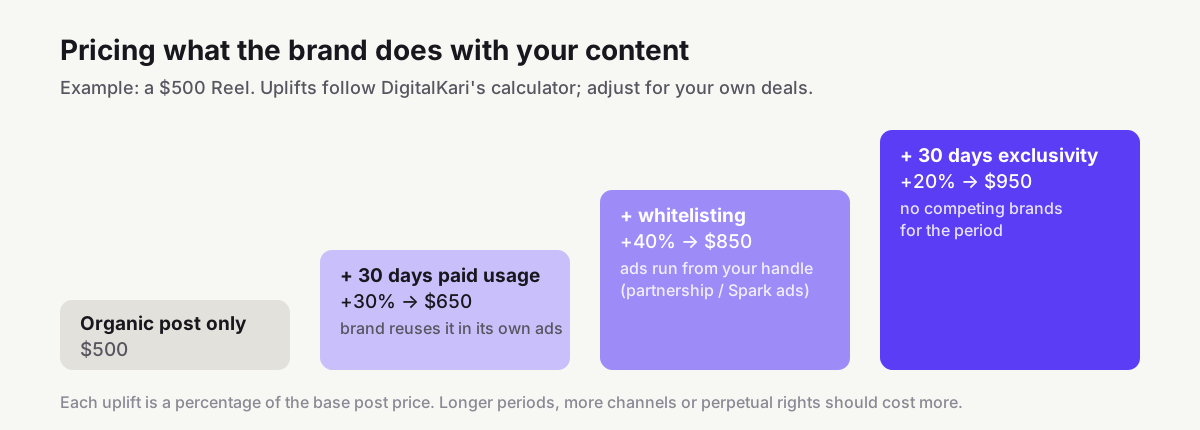
There is no official rate card for usage. The practical approach is to price each right as a percentage of your base post fee, so the price scales with your audience. Our sponsored post rate calculator uses these starting points:
| Right | Starting uplift | Scale it up when… |
|---|---|---|
| Paid usage (30 days) | +30% | longer periods, more channels (TV, outdoor), more countries |
| Whitelisting / partnership ads | +40% | account-level access, large ad budgets, long authorization |
| Category exclusivity (30 days) | +20% | broad categories, long periods, your niche has many sponsors |
| Perpetual or full ownership | Negotiate | always; this removes your future earning from the content |
What to put in the contract
- Which content: list the specific posts or videos.
- Which use: organic reshare, paid ads from the brand's account, or ads from your handle.
- Which channels and countries: social only, or also website, email, TV, outdoor.
- Start and end dates, and that all ads stop on the end date, whatever the platform toggle shows.
- Whether the brand may edit, cut or add text to your content.
- The fee for each right, and the price to extend.
- Who handles disclosure on the ad versions.
On that last point: the FTC's guidance says responsibility for disclosure rests with the influencer and the brand, not the platform, and that it's always best to add your own disclosure even when a platform offers a tool. Brands are ultimately responsible for what others do on their behalf. Agree in writing how paid versions of your content will be labelled. Our disclosure guide covers the rules in the US, UK and India.
Key takeaways
- Your base fee covers an organic post. Usage, whitelisting and exclusivity are extra.
- Match platform authorization periods to what you've been paid for, and write the end date into the contract.
- By default you usually own what you create; license it for a period instead of assigning it.
- Use the negotiation guide to trade these rights when a brand's budget is tight.
Platform features and legal guidance reflect the sources below as reviewed on 29 October 2026. This guide is general information, not legal advice.
References
- About partnership ad permissionsInstagram Help Center
- Stop an advertiser from running partnership ads from your accountInstagram Help Center
- Create a partnership ad code to share with partnersInstagram Help Center
- About Spark AdsTikTok for Business Help Center
- How to create Spark Ads for Smart+ campaignsTikTok for Business Help Center
- Creator partnerships boostGoogle Ads Help
- Copyright Basics (Circular 1)US Copyright Office
- Works Made for HireUS Copyright Office
- FTC's Endorsement Guides: What People Are AskingUS Federal Trade Commission
We link to primary sources where possible. Rules and figures change; check the source for the current version.