YouTube Shorts vs long-form: which earns more, and when to use each
Shorts are paid from a shared pool split by view share; long-form videos earn from ads on the video itself. At the same view count the gap is dramatic, but the smartest channels use both.

"Should I make Shorts or long videos?" is one of the most common questions new YouTubers ask, and the honest answer is that they do different jobs. Shorts are excellent at reaching new viewers; long-form videos are where advertising money concentrates. This guide explains exactly how YouTube pays for each format, shows what the same number of views is worth in each, and sets out how to combine them.
How each format is paid
Long-form: 55% of watch-page ad revenue
When a viewer watches one of your regular videos, ads run on and around that video. YouTube's partner earnings overview says creators receive 55% of net revenue from ads on the watch page. Because the ad is attached to your video, the revenue is attached to you, and your niche, audience location and video length all feed straight through to your earnings.
Length matters because YouTube lets you place mid-roll ad breaks on monetized videos that are 8 minutes or longer. More ad breaks mean more chances to earn from each view, as long as viewers are still watching when the breaks arrive.
Shorts: 45% of a Creator Pool allocation
Shorts work differently, because ads appear between Shorts in the feed rather than inside any one video. YouTube's Shorts monetization policies describe the process:
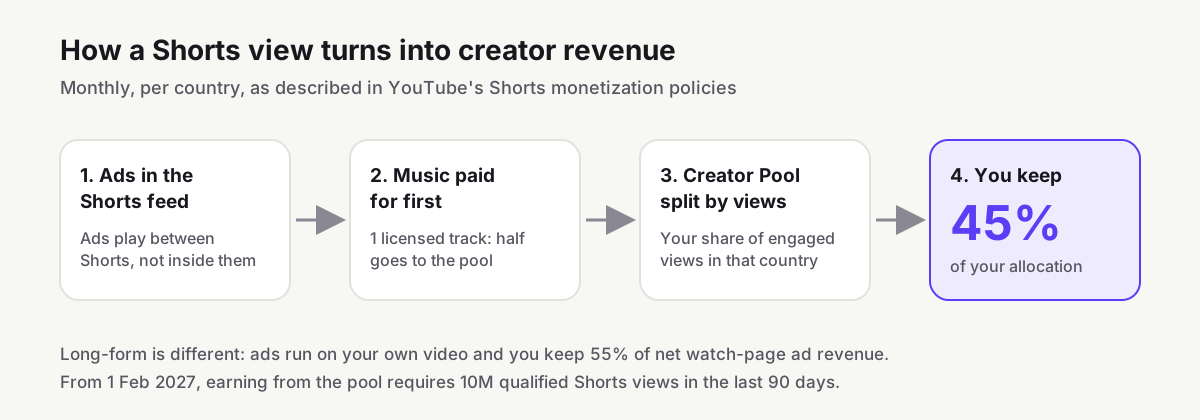
- Ad revenue from the Shorts feed is pooled each month, per country.
- Music licensing is paid for first. A Short with no licensed music sends all of its revenue to the Creator Pool; one with a single track sends half, two tracks a third, and so on.
- The Creator Pool is shared among monetizing creators by their share of engaged Shorts views.
- Creators keep 45% of their allocation, a rate YouTube says applies whether or not music was used.
The key consequence: your Shorts income depends on your share of all Shorts views, not on the advertisers interested in your particular topic. A finance Short and a comedy Short with the same views in the same country earn roughly the same.
Same views, very different income
Using the model behind our ad revenue calculator for a lifestyle channel with a mostly US, UK, Canadian or Australian audience:
| Format | Estimated RPM | 100,000 views | 1 million views |
|---|---|---|---|
| Long-form, 8 min+ | $4.75–$10.45 | $475–$1,045 | $4,750–$10,450 |
| Long-form, under 8 min | $2.85–$6.65 | $285–$665 | $2,850–$6,650 |
| YouTube Shorts | $0.08–$0.34 | $8–$34 | $79–$344 |
At the midpoint, the long-form video earns about 36 times more per view than the Short. Put another way, reaching $1,000 a month takes roughly 130,000 long-form views but close to 5 million Shorts views at these rates.
The gap widens further in valuable niches. Long-form finance content can earn several times the lifestyle figure, while a finance Short earns only a little more than a lifestyle Short, because the Creator Pool spreads advertiser money across all Shorts. Our guide to the highest-paying YouTube niches goes into why.
Read RPM per format, not channel-wide
YouTube defines RPM as how much you have earned per 1,000 views, counting every view including ones that showed no ad. It also notes that RPM can fall when unmonetized views rise. Shorts views therefore drag a channel-wide RPM down sharply, which can make a healthy long-form channel look like it's earning poorly. In YouTube Studio's revenue analytics, compare RPM for Shorts and long-form separately before drawing conclusions.
What changes for Shorts in 2027
YouTube has announced changes to its Partner Program taking effect on 1 February 2027. New applicants for ad revenue will need 1,000 subscribers plus 8,000 qualified watch hours in the last 365 days, or 20 million qualified Shorts views in the last 90 days. Separately, to keep earning from the Shorts Creator Pool, a channel will need to maintain 10 million qualified Shorts views over the last 90 days. Falling below that doesn't remove a channel from the program, but it stops Shorts pool earnings. For smaller channels, Shorts ad revenue is likely to become an even less reliable income source.
Use Shorts as a funnel, long-form as the business
None of this means Shorts are a waste of time. They are one of the fastest ways for a channel to be discovered, and new subscribers who arrive through Shorts can go on to watch your long-form videos, where each view is worth far more. A practical system:
- Cut Shorts from long videos. Take the strongest 30 to 60 seconds of each long video as a Short, and link the Short to the full video so curious viewers have somewhere to go.
- Test ideas cheaply. A topic that does well as a Short is a strong candidate for a full video.
- Judge Shorts on growth, not revenue. Track subscribers gained and traffic to long-form videos, not Shorts RPM.
- Make long videos that earn their length. Tutorials, reviews and explainers that naturally run 8 to 15 minutes unlock mid-rolls without padding.
Which to prioritise
| Your goal | Lean towards | Why |
|---|---|---|
| Ad revenue | Long-form, 8 min+ | 55% share on your own video plus mid-roll breaks |
| Fast discovery | Shorts | Reaches non-subscribers at scale |
| Reaching the Partner Program | Mix of both | Shorts build subscribers; long-form builds watch hours |
| Brand deals | Long-form integrations | Sponsors pay more for longer, spoken segments |
Run your own numbers in the ad revenue calculator: switch the format between long-form and Shorts at your real monthly views to see the difference for your niche and audience. For sponsorship income, which usually dwarfs Shorts ad revenue, use the sponsored post rate calculator.
Revenue shares and program rules reflect YouTube's help pages as reviewed on 29 October 2026. Estimates come from DigitalKari's calculator model, not from YouTube.
References
- YouTube partner earnings overviewYouTube Help
- YouTube Shorts monetization policiesYouTube Help
- Changes to the YouTube Partner ProgramYouTube Help
- YouTube Partner Program overview & eligibilityYouTube Help
- Manage mid-roll ad breaks in long videosYouTube Help
- Understand ad revenue analyticsYouTube Help
We link to primary sources where possible. Rules and figures change; check the source for the current version.