How much should creators charge for sponsored posts? (2026 rate benchmarks)
The old rule of a fixed price per thousand followers no longer reflects what brands buy. Price on the views you deliver, add your niche, then charge separately for every extra right a brand wants.

For years creators priced sponsorships with a rule of thumb: a fixed amount per thousand followers. It was easy to calculate and increasingly misleading, because followers no longer tell you how many people will see a post. Brands now judge creators the way they judge advertising: what does it cost to reach real viewers? This guide gives you the two formulas brands recognise, rate ranges by creator size for four platforms, and the add-ons that turn a single post into a properly priced deal. You can run your own numbers at any point in the sponsored post rate calculator.
The two pricing formulas: CPM and CPE
Formula A: price on views (CPM)
price = average views ÷ 1,000 × sponsored CPM × niche multiplier
CPM, the cost per 1,000 views, is the language brand teams already use for paid ads, so it makes your price easy to compare. It also matches how brands search for creators: TikTok One lets them filter by median video views and engagement rate, alongside audience location, age and gender. Use your average or median over your last 10 posts, not your best post. On Instagram, use views, which Meta made its primary metric in 2024 (views count repeat plays; reach counts unique accounts).
The calculator uses these CPM ranges, before the niche multiplier:
| Platform | Deliverable | CPM range |
|---|---|---|
| Reel or post | $15–$30 | |
| TikTok | Video | $10–$25 |
| YouTube | 60–90 second integration | $20–$45 |
| Post (impressions) | $30–$60 |
Formula B: check it on engagement (CPE)
CPE = price ÷ (likes + comments + shares/saves)
Cost per engagement tells a brand what each interaction costs. Rather than pricing from a CPE target, use it as a second argument for the price you've already set. A $450 Reel averaging 15,000 views with a 4% engagement rate on views earns about 600 interactions, or roughly $0.75 each. If your engagement is high, your CPE looks cheap, which is a strong reply when a brand pushes back. Get your interaction figures from the engagement rate calculator.
Rates by creator size
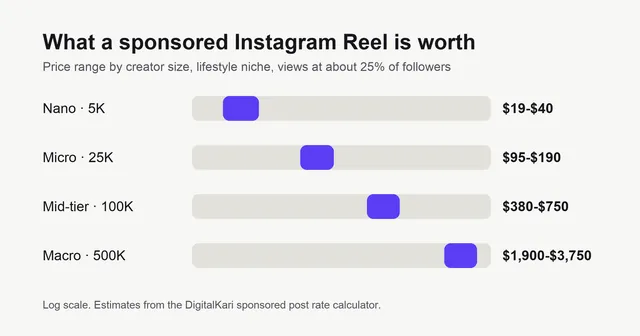
Below is what the calculator returns for a lifestyle creator at five sizes, assuming typical views as a share of followers for each platform (Instagram about 25%, TikTok 35%, YouTube 12%, LinkedIn 8%):
| Creator size | Instagram Reel | TikTok video | YouTube integration | LinkedIn post |
|---|---|---|---|---|
| Nano · 5K | $19–$40 | $18–$45 | $12–$25 | $12–$25 |
| Micro · 25K | $95–$190 | $90–$220 | $60–$135 | $60–$120 |
| Mid-tier · 100K | $380–$750 | $350–$880 | $240–$540 | $240–$480 |
| Macro · 500K | $1,900–$3,750 | $1,750–$4,400 | $1,200–$2,700 | $1,200–$2,400 |
| Mega · 2M | $7,500–$15,000 | $7,000–$17,500 | $4,800–$10,800 | $4,800–$9,600 |
How this compares with what brands report spending. In Influencer Marketing Hub's 2026 survey of more than 600 respondents, about 55% of cost answers for nano creators were under $500, as were about 45.5% for micro creators. For mid-tier creators the most common answers were $2,000–$5,000 and $5,000–$10,000, each about 22%. Those figures run higher than a single view-based post because survey answers typically describe whole deals: several deliverables, usage rights, exclusivity and sometimes agency fees. Treat the table above as your base fee for one organic post, and build up from it.
Adjust for your niche
Advertisers who earn more per customer can pay more per view. The calculator applies 1.6× for Tech & Finance, 1.15× for Beauty & Fashion, 1.0× for Lifestyle and 0.85× for Gaming. A micro tech creator's Reel moves from $95–$190 to about $150–$300. Audience location matters too: if most of your viewers are outside the US, UK, Canada and Australia, quote towards the lower end for global brands, or pitch regional brands that want your market.
The add-ons that raise the total
The base fee covers an organic post. Everything else a brand wants should be priced on top, as a percentage of that fee:
| Add-on | Calculator uplift | What it covers |
|---|---|---|
| Paid usage rights (30 days) | +30% | Brand reuses your content in its own ads |
| Whitelisting / partnership ads | +40% | Ads run from your handle (Instagram partnership ads, TikTok Spark Ads) |
| Category exclusivity (30 days) | +20% | No competing brands for the period |
| Rush delivery (under 72 hours) | +20% | Compressed turnaround |
Instagram partnership ads and TikTok Spark Ads both require your permission before a brand can run your content as an ad. Instagram via partnership ad permissions, TikTok via an authorization code. That permission is what you're charging for. For contract wording and durations, see our usage rights and whitelisting guide.
Packages raise deal value without cutting your rate: the calculator suggests a three-post package at 10% off and a monthly retainer (four main posts plus four lighter pieces) at 15% off.
Putting the price in your pitch
Lead with the idea and your proof, then the price. A short version:
Hi [Name],

I'm [name], a [niche] creator on [platform]. My last 10 [Reels/videos] averaged [views] views, mostly from [top countries].

I'd love to make a [format] about [specific idea] featuring [product]. My rate for one [format] is [$X–$Y], and I offer a three-post package at [$Z]. Usage rights and whitelisting are available on top.

Could I send over my media kit and a one-paragraph brief?

[Name]
More templates are in how to pitch brands as a small creator, and the media kit guide shows what to attach. When a brand pushes back, use our negotiation guide to trade scope instead of cutting your rate.
If you're just starting out
At a few thousand views per post, view-based prices are small, and some brands offer free product plus a modest flat fee instead. That can be worth it for products you would genuinely use, but it is still an advertising relationship: the FTC says free or discounted products count as a material connection that must be disclosed. See our disclosure guide. Track your views, and move to paid rates as they grow.
Frequently asked questions
What is the standard formula for pricing a sponsored post?
Price on views: average views ÷ 1,000 × a sponsored CPM × a niche multiplier. DigitalKari's calculator uses CPM ranges of $15–$30 for an Instagram Reel, $10–$25 for TikTok, $20–$45 for a YouTube integration and $30–$60 for LinkedIn, before adjusting for niche.
Should creators price brand deals on followers or views?
Views. Brand tools such as TikTok One let brands filter creators by median video views and engagement rate, so a price built on the views you actually deliver is easier to justify than one based on follower count.
How much extra should I charge for usage rights or whitelisting?
Price each right as a percentage of your base fee. DigitalKari's calculator starts at +30% for 30 days of paid usage, +40% for whitelisting or partnership ads from your handle, and +20% for 30 days of category exclusivity, and longer or broader rights should cost more. These are a starting framework, not an industry standard.
Why do brands in surveys report paying more than view-based estimates?
Survey answers usually describe whole deals: several deliverables, usage rights, exclusivity and agency fees together. A view-based price is the base fee for one organic post, so treat it as your floor and add packages and rights on top.
What should a nano creator charge?
At a few thousand views per post, a view-based price is often under $100. Some brands offer free product plus a modest flat fee at this level. Use the estimate to judge whether an offer is fair, label any gifted post as an ad, and raise prices as your views grow.
Survey figures reflect the sources below as reviewed on 29 October 2026. Rate ranges are DigitalKari calculator estimates; see the earnings disclaimer.
References
- Influencer Marketing Benchmark Report 2026Influencer Marketing Hub, 4 May 2026
- How to find creators who work with TikTok OneTikTok for Business Help Center
- Introducing Views to simplify content distribution metricsMeta for Creators, 14 November 2024
- About partnership ad permissionsInstagram Help Center
- About Spark AdsTikTok for Business Help Center
- Disclosures 101 for Social Media InfluencersUS Federal Trade Commission
We link to primary sources where possible. Rules and figures change; check the source for the current version.